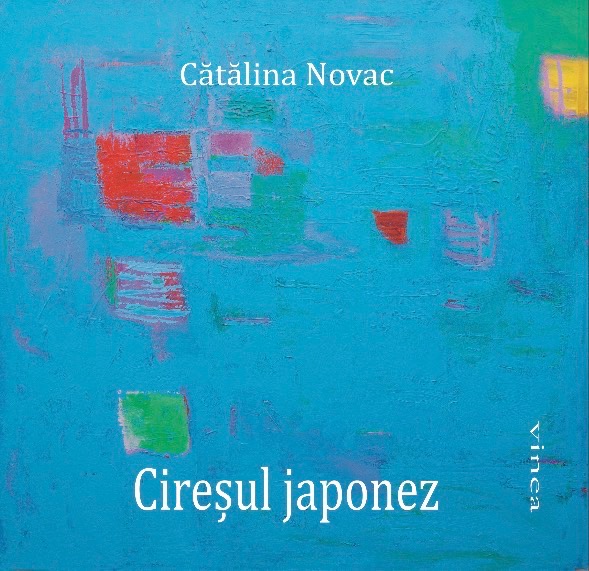
Cătălina Novac is not among those poets who turn away from reality or seek to shield themselves from it by replacing it with the imagined coordinates of poetry. On the contrary, in her verses reality is taken up and transformed into the very substance of poetry—confronted, reshaped, and, at times, even overcome.
The Japanese cherry tree, the Boboli Gardens, the Trivale Forest, the Palazzo Barberini become landmarks within a personal geography, where carefully chosen objects and animals gather: the revered tiger, the electric bicycle, the sun hat, the dog Max, the Australian snake.
Through poetry, the world is both embraced and redeemed—and the courage of this embrace springs from a heightened sensitivity that bestows gentleness, beauty, and a quiet serenity upon both reality and the poem itself.
— Ana Blandiana
This volume of poems, The Japanese Cherry Tree, is not, above all, addressed to those who favor ornament over what we call substance. At the level of poetic language, this means that the denotative function is given precedence over the so-called connotative one. Words are, as a rule, allowed to rest in their dictionary meanings, without yielding to the many forms of ambiguity—from the confusions of synonymy to the subtler play of submerged meanings that shimmer around them like the waters of the underworld at noon.
Cătălina Novac prefers the “clear and distinct” lens of the thinker from The Hague to any kaleidoscopic mélange, as well as to every other form of semantic excess. This, of course, is a matter of principle—for metaphor is innate to us and, like a shadow, cannot be separated from what we are. And yet, her inclination toward the literal over the figurative sometimes draws her toward a kind of natural social (or ethical) militancy, one that seems to carry echoes of a “serenade of the axe,” in the manner of Bacovia: “Ten children die of hunger in an hour / Others collapse on their road to the relief center / Does justice exist?”
Of course, it is not poetry’s obligation, once it has posed its questions, to provide answers as well…
A warm welcome to you, Cătălina!
Șerban Foarță